— This upcoming video may not be available to view yet.
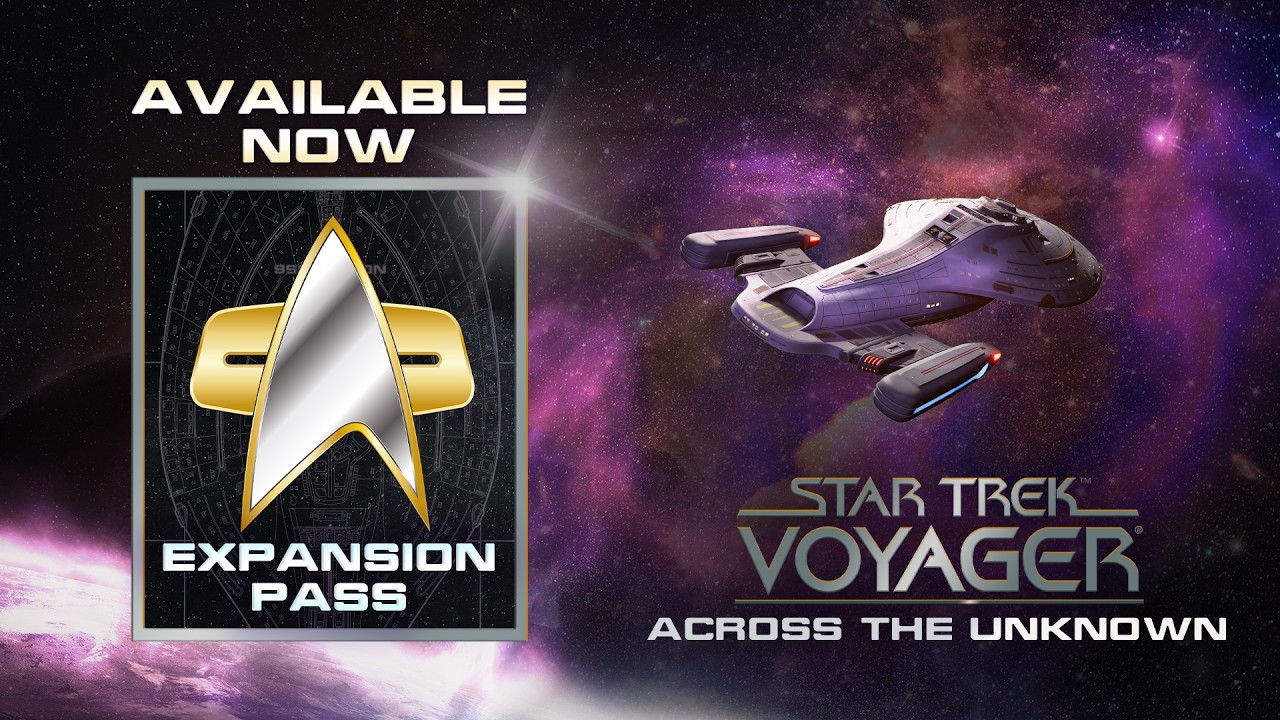
Daedalic Entertainment and Gamexcite have announced downloadable content for Star Trek: Voyager - Across the Unknown, including some that is already out now.
In my earlier post about the base game, I noted a few things I’d like to see in a DLC. Very little detail has been confirmed and I don’t really expect much of the specifics of my suggestions to make it.
However, one thing has been confirmed: a mode featuring the U.S.S. Equinox. And honestly I’m happy to see any extra support.
The first DLC is available now with the rest coming throughout the year. Hopefully if it is successful, there will be more.
DLC 1: Delta Chronicles – available now.
New missions, recruitable heroes, six new technologies and four NPC ships.
DLC 2: U.S.S. Equinox - soon
Contains a completely new, playable ship along with crew, technology and more.
DLC 3: later this year
Contains more missions, heroes, technologies and NPC ships.
DLC 4: New sector - later this year
Contains a whole new sector with storyline, missions, characters, NPC ships and technologies.
— This upcoming video may not be available to view yet.
I recently bought Star Trek: Voyager - Across the Unknown, a story-driven survival strategy game developed by Gamexcite and published by Daedalic Entertainment.
In fact, I pre-ordered it. Pre-ordering is something I tend to reserve for things I feel the need to signal support for that might otherwise struggle. I was a big fan of Star Trek in the 90s and early 2000s, and while recent Star Trek has been more of a mixed bag for me, I was excited for a new game based on this era, even if some of that is nostalgia.
It is surprising that anyone would base a game on a TV show that last aired nearly 25 years ago, and probably a bit of a gamble. That said, the last Star Trek: Voyager game I played was Elite Force, which was projected to sell 700,000 units but reportedly only sold around 300,000 worldwide which was considered an underperformance. Across the Unknown has already sold 100,000 units; whether that meets its presumably more modest target I can’t say, but it at least suggests I’m not alone in my nostalgia for this era of Star Trek.
Spoiler warning: The rest of this post contains spoilers for the game (and, in case it matters, Star Trek: Voyager).
Gameplay summary
The game is strongly structured around the major events of the show like the Kazon, the Borg, the Hirogen, the Borg again, which you encounter in order. These can’t be avoided, but how you handle them is up to you. Smaller, less significant events from the show are scattered throughout as optional encounters that you have to seek out.
In terms of feel, it’s a bit like Fallout Shelter (I mean the ship overview even looks like Fallout Shelter). Resource management is the foundation, with the most significant resource being morale. If it gets too low crew will mutiny. You make the decisions, whether to be diplomatic or aggressive, whether to embrace dangerous technologies like Borg research, and the game features roguelike elements, so each run plays out differently, with crew members permanently lost if things go wrong.
Advice to new players: If you leave a sector while someone is off the ship, they will be gone forever. The game technically warns you of this but is a bit understated, and sometimes you may have even missed that someone was off the ship. In my current run I guess I’ll never know what happened to Tom.
The game also covers ship management (repairing and constructing rooms, managing energy and life support), exploration, away missions, and ship-to-ship combat. The combat is a bit basic, but to be honest I think that fits in with the way combat has always worked in the show. In fact it is interesting how much Star Trek games have focused on robust combat mechanics when it was never really like that on-screen.
My thoughts
The introductory mission with the Caretaker is a bit long and a little annoying to play more than once, though you can influence things - including ending the game early by simply using the Caretaker’s array to go home.
Initially it feels like you follow the show’s story very closely, which can feel restrictive. But there is more flexibility than it first appears. You can recruit Seska, recruit a Kazon, lose Chakotay, and end up with zero, one, or more of human Torres, Klingon Torres, and “real” Torres. And of course you get to choose what happens to Tuvix.
The dialogue is not amazing, but somehow quaint. There is generally no voiceover except for the sector introductions by Tim Russ and Robert Duncan McNeill.
The game is hard. There are three difficulties - “Adventure”, “Survival”, and “Years of Hell”. I initially tried “Survival”. I thought it was quite easy and things were going well, until everything fell apart. I’ve since dropped to “Adventure” and I’d recommend it as a first playthrough since it is the best for exploring “what if?” scenarios.
Should you buy it
If you are a fan of Star Trek: Voyager, absolutely. If you are a fan of Star Trek of this era and want more video games based on it, then also absolutely. If you are a fan of Star Trek in general and are at least moderately interested in roguelikes or resource management games, then probably. Otherwise, it’s harder to say. On its own merits, without being based on Star Trek: Voyager, I’m not sure how well it stands up.
If you are a fan of the show, some of the elements are strongly telegraphed. For example, while fighting the Kazon you find out there is a traitor on the ship. If you watched the show you know who it is, and that can’t be changed. You can influence what happens, but you already know who to trust. This continues throughout the game, and many of the optional side missions are even named after the relevant episodes so you can see what is coming. It’s an interesting choice. Part of me wants to see what a playthrough by someone who hasn’t seen every episode several times would look like.
Suggestions for improvements
It would be nice if the player could control the ship right from the start while trying to find Chakotay and the Maquis. Some mechanics could remain locked, but it could be a good way to tease the player with what they can achieve by briefly showing them a fully functioning Voyager.
The away team mechanics are pretty cool but there aren’t enough missions. It would be good to see more of them, and perhaps with a bit more secrecy - currently you can see all the required specialties before starting a mission, which makes things a little too gameable. There’s also an opportunity to introduce random events during missions. The Star Trek CCG is structured around missions and dilemmas, where dilemmas represent generic1 things that could go wrong on a mission that the crew have to deal with. Something like that could work well here. Similarly, most space locations are just random resource gathering, and it would be interesting to see some kind of minigame introduced there too.
More randomness in general would be welcome. My ideal would be the ability to choose how closely the story matches the show when starting a run: what if Seska isn’t the traitor, or the crew encounter the Hirogen before the Kazon, or some entirely original events are introduced? On a similar note, playing with different ships could be interesting. Some suggestions I’ve seen are a harder mode based on the U.S.S. Equinox or Defiant-class, or an easier mode in a Galaxy-class ship. Probably beyond scope for a DLC, but someone suggested a version based on navigating the Delphic Expanse from season 3 of Enterprise, which I’d happily play.
Okay, most of them aren’t generic and some care would be needed to not introduce some absurdity. Finding out the universe only has seventy trillion years left and working out what you should do about it, while trying to retake Voyager from the Kazon, would be weird. ↩︎
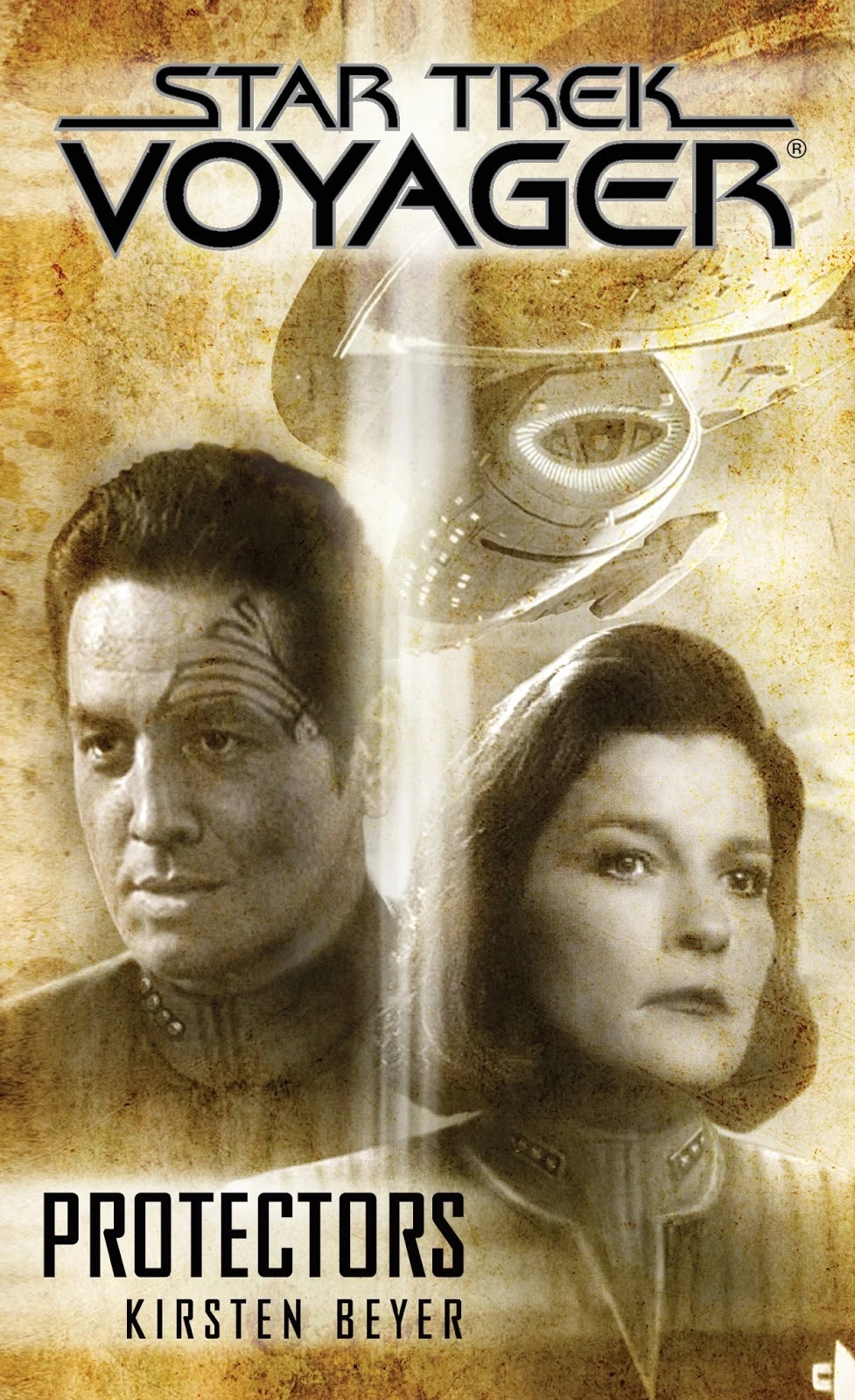
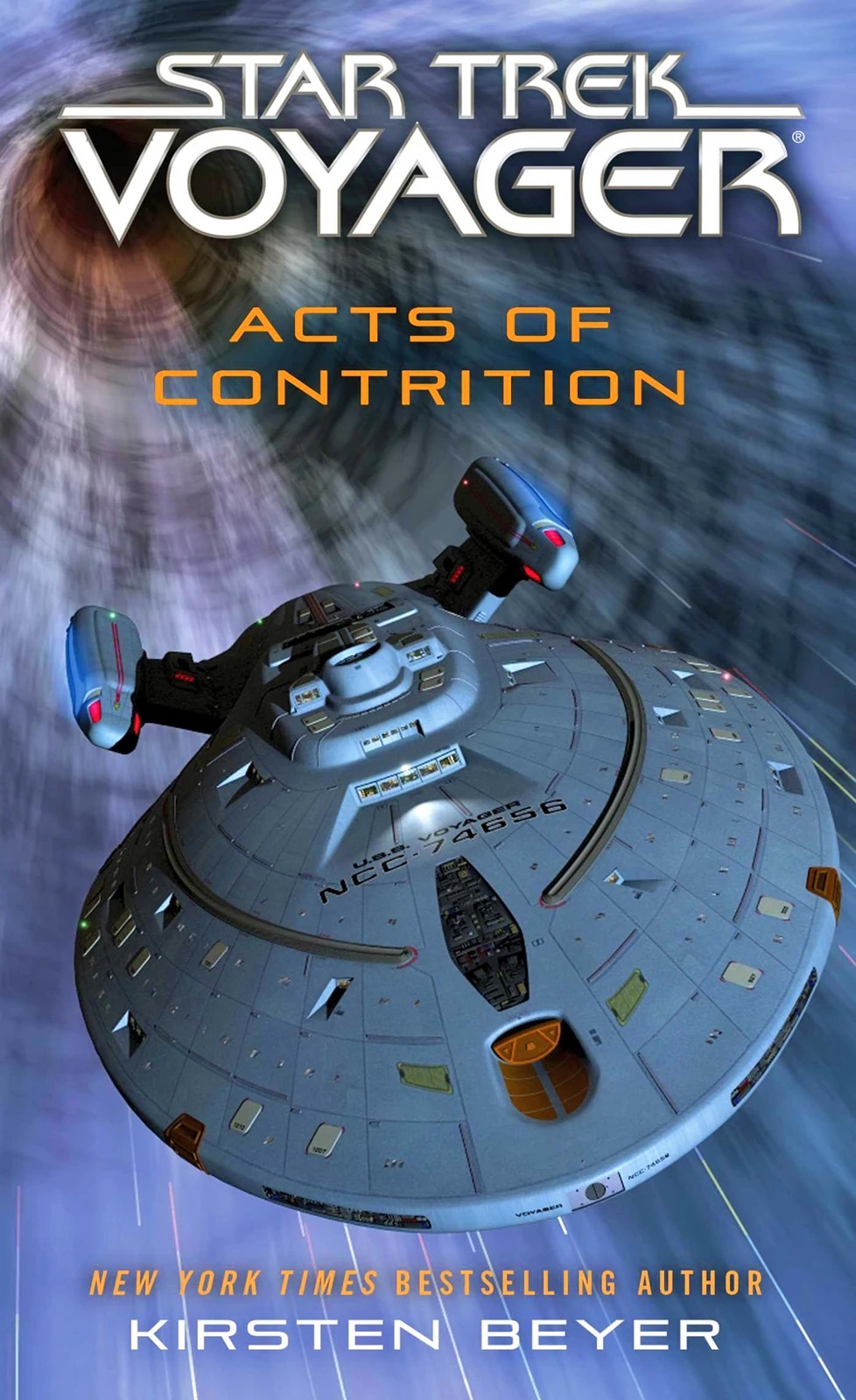
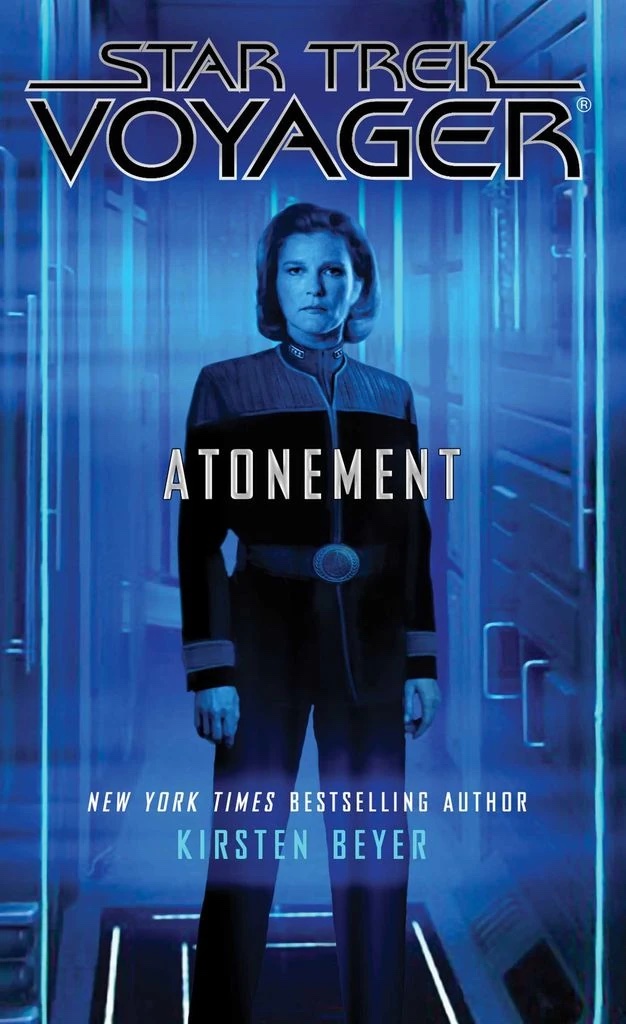
Although the title suggests this is just a review of Atonement (and is biased towards it), this is really a review of the three Voyager novels The Protectors, Acts of Contrition, and Atonement which essentially make up a single story.
As a warning, this book (and by extension this review) contains heavy spoilers for the Destiny series, and the earlier Voyager relaunch stories (Full Circle to Eternal Tide).
Voyager and its crew and allies face some of the consequences of their first trip through the delta quadrant, while Seven of Nine struggles with the changing attitudes of the Federation following the events of Destiny.
One of the reasons I like Star Trek now is the sheer wealth of material available. The novels have been going from strength to strength, expanding the material in ways that would not have been possible while the show was still on TV. Despite this, I was a little concerned when the Voyager relaunch series began in Full Circle and immediately introduced a lot of new characters at once, and did so in a way that suggested they were going to stick around and be important. I think this trilogy has proven the idea was worth it.
At its core, there are two stories going on simultaneously, one in the Federation and one with the Full Circle fleet in the delta quadrant. Plot-wise they have nothing to do with each other and could have happily existed in separate works. Despite this, they do work well together solely because of the complicated relationships between all the characters - partly the existing ones between the characters we all know, but also significantly with the new ones introduced. Characters’ actions were frequently motivated by their relationship with those in the ‘other’ story so this structure helped emphasize this in a way that would have been lost had they been separate.
The Federation storyline deals with unexpected fallout from the destruction of the Borg. Seven of Nine and Tom Paris leave the Full Circle fleet to help with this in a story centred around the ethics and morality of the Federation trying to rebuild too quickly. Both Seven and Tom have to deal with the fact that they’ve spent years with a crew who respect and trust them, but now have to face an outside world that doesn’t. After all, Seven is not only a former Borg drone, but also one of only a handful that didn’t join the Caeliar gestalt; while Tom is still regarded as rebellious (and only kept in Starfleet due to Janeway’s influence) as well as reckless because of his handling of the situation with his daughter in Unworthy.
Described broadly, this idea of characters redeeming themselves, and being better than they appear is a common plot for Star Trek. But it is also one that works well, especially because of the complex interactions with the secondary characters (The Doctor, Axum, Samantha Wildman, Icheb and Admiral Akaar all feature to varying degrees).
The Full Circle fleet storyline also follows another typical plot found in Star Trek: how the Federation deals with large powers that don’t quite match their ideals, and specifically what happens if they try to subject a member of the Federation to their own idea of justice. Unfortunately, the ultimate resolution to this ends up a bit weak, but as consolation it leaves the door open for more in the future.
Constantly switching between the two plots is a little frustrating at times, but only because each one is so engrossing. During it all, the new characters in the Full Circle fleet get enough time to get some depth and feel important (and in some cases like Liam O’Donnell, to stop feeling like one-dimensional caricatures). This didn’t blow me away like some have (like DTI: Watching the Clock or the Mirror Universe series), but it’s better than most other recent novels and is definitely the best of the Voyager relaunch and worth reading if you have any interest in Voyager. Although you should probably start at Full Circle and read them all.